
Noted scientist Prof V Ramgopal Rao highlights India's significant progress in higher education and research but points out a critical gap in converting scientific discoveries into market-ready technologies. He advocates for a robust institutional framework, multidisciplinary collaboration, and stronger academia-industry ties to foster innovation and translate research into practical products.

A Mumbai sessions court has refused to overturn a magistrate's order directing police to register an FIR against an erstwhile trustee of the Lilavati Kirtilal Mehta Medical Trust. The FIR pertains to allegations of fund misappropriation and harassment that allegedly led to the death of trustee Kishor Mehta. The court found the magistrate's order to be "well within jurisdiction."

India and China are in what experts call 'a cooperation-versus-competition situation'.

Alphabet has announced a significant leadership reshuffle within its artificial intelligence division, appointing Google DeepMind co-founder Demis Hassabis as Chief Scientist to intensify its focus on artificial general intelligence (AGI). Koray Kavukcuoglu will become Senior Vice President of Google DeepMind, overseeing Gemini development and frontier AI research. Additionally, Google veterans Jeff Dean and Sanjay Ghemawat are launching a new public benefit corporation for ML and science discoveries, supported by Google.

Members of the Reserve Bank of India's (RBI) Monetary Policy Committee (MPC) have indicated that interest rate hikes may be necessary sooner rather than later, as headline inflation is projected to rise from its current benign levels in the coming months, according to the minutes of the August review.

The University of Sheffield has announced a major milestone in the push for greener aviation as it produces its first report from testing a new sustainable aviation fuel (SAF). The research is helping support the faster rollout of low-carbon jet fuels.

'Tariff action relating to the excess-capacity investigation will be even more susceptible to judicial overturn.'

A lesson for India is to clearly define objectives beforehand, so that the adversary or other parties do not attempt to mitigate them midway.

Despite aggressive expansion, India's solar power sector faces significant hurdles from rising regional disparities in installed capacity and a looming manufacturing glut due to overcapacity in domestic solar equipment production, potentially leading to consolidation and pricing pressures.

Dr Dinesh Amalnerkar, president of the Maharashtra Academy of Sciences, has emphasised the need for Maharashtra to strengthen its semiconductor research and manufacturing ecosystem to compete with states like Gujarat and Telangana.

Dr Subhash Kashyap not only enhanced Parliament's image in India and abroad, but also the position of Lok Sabha secretary-general which succeeding secretary-generals have upheld thorough neutrality, objectivity and high degree of professionalism, notes Rup Narayan Das.

Notwithstanding the economic complementarities and the host of agreements for deepening economic relation on a host of areas, both sides share common viewpoints on the foreign policy domain and seek common grounds to serve as a counterweight to China, notes Dr Rajaram Panda.

The upcoming Tata Sons board meeting in June could possibly throw some light on several critical issues that may have a bearing on the future of the corporate behemoth.

Vietnam is an emerging regional power and a closer relationship with Hanoi is closely aligned with Prime Minister Narendra Modi's Act East Policy, points out Dr Rajaram Panda.

A new study reveals that immune cells within brain tumours may be manipulating sugar metabolism, specifically breaking down fructose, to suppress immune responses and promote tumour growth. Blocking fructose breakdown in these cells could improve immunotherapy outcomes for glioblastoma patients.
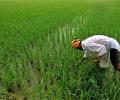
India is already a heavyweight in global farm trade in pockets such as rice exports, but experts are urging a pivot from a subsidy- and procurement-driven mindset to a productivity and nutrition strategy that still shields farmers from volatility.
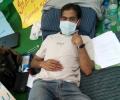
Research scholars took to the streets against the Union government's neglect towards raising the fellowship amount

US lawmakers have expressed concerns that policies enacted by the Trump administration, such as the H1B visa fee and tariffs on India, are detrimental to American businesses and threaten the relationship between the United States and India.

Prime Minister Narendra Modi and Chinese President Xi Jinping are expected to hold bilateral meetings on the sidelines of the SCO summit in Tianjin, as both nations look to strengthen ties amid global trade tensions.

'The tools of warfare are changing. The MoD must deepen its engagement with technology thinkers that can present compelling visions of where warfare may be heading.'

'Our problem is not a budget deficit but a trust deficit. We need to trust our institutions and industries to innovate and lead. That is the way forward for India.'

'The heat shield technology for re-entry vehicles was first mastered in DRDO for the Agni missile.' 'This is why the Americans were so opposed to Agni in the 1980s, unlike other missiles -- it was a re-entry vehicle.'
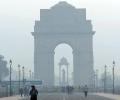
'Most pollution boards across the country have unused funds. There is practically no reason why pollution should not be a political priority.'
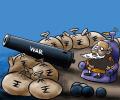
Almost a decade after India shifted to a formal inflation-targeting regime under the Monetary Policy Committee (MPC) framework of the Reserve Bank of India (RBI), a high-level panel of economists said that the flexible inflation targeting has largely worked in keeping it under control and no major revamp is required.

Tata Sons, now debt-free, has asked the RBI to drop its 'upper-layer NBFC' tag and allow it to stay private.

The Pahalgam massacre highlights the evolution of terrorism into a multi-domain challenge. India's response must similarly evolve -- from tactical retaliation to comprehensive strategic deterrence. To establish a credible and sustained deterrent, India must also carry out continuous kinetic operations, both overt and covert, suggest Sakshit Raina and Rahul Mishra. To establish a credible and sustained deterrent, India must also carry out continuous kinetic operations, both overt and covert, suggest Sakshit Raina & Rahul Mishra.

Can change happen? Not unless the changemakers themselves want it since they benefit the most from the status quo, warns Biswajit Dasgupta.
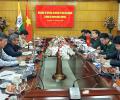
The 15th India-Vietnam Defence Dialogue signalled a move from routine talks to deeper cooperation, with new deals on submarine rescue and defence industry to support stability in the Indo-Pacific, notes Dr Rajaram Panda.
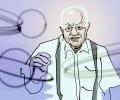
Jayant Narlikar wrote alternative what-if histories, explained difficult scientific theories with funny analogies, and leavened his lectures with jokes and humorous asides.
When the world is happily dealing with unstable countries, why shouldn't India? asks world's leading geo-strategist Parag Khanna.

'Geopolitically and diplomatically it's a very difficult situation for India.'

Economics will dominate the future relationship between China and India and it will be characterised by competition and collaboration simultaneously, says an official of ISAS.
Shikha Bhatnagar's recent appointment as Associate Director of the South Asia Center of the Atlantic Council, is yet another manifestation of a growing trend of second generation Indian Americans' advent into leading Washington, DC think tanks as senior policy analysts and associates.
Instead of trying to benefit from India's economic growth, Pakistan is expected to continue with its anti-India narrative by not only continuing to build up its nuclear arsenal, but also support terrorist outfits as proxies, American lawmakers have been told.

We have to be much more rigorous and analytical in assessing the importance of the BRICS, says Parag Khanna.
There were also concerns over whether a depreciating rupee would increase the fiscal deficit by increasing expenditure on subsidies and jeopardise the repayment schedule for external commercial borrowings.
The United States and India need to stop being suspicions of each other's intentions and deepen intelligence sharing if they are to effectively combat terrorism, a leading South Asia expert and erstwhile Central Intelligence Agency analyst has told the US Congress.

Commuters on national highways and expressways will need to pay more for their road journeys, as the National Highways Authority of India (NHAI) has increased toll charges by an average of 4 to 5 per cent on highway sections across the country. The revised toll charges for motorists on national highways across the country have come into effect from Tuesday, a senior highways ministry official told PTI.
Sarmila Bose's book on the 1971 Bangladesh War -- Dead Reckoning -- has triggered a heated debate about the myths and realities of the conflict that had engulfed East Pakistan, West Pakistan and India.
